In 2026, as urban land prices rise and grid capacity becomes tighter, choosing the right charging station architecture is a million-dollar decision. Should you go for a compact All-in-One unit or a scalable Modular Design?
At MM Global Energy, we help global operators analyze which configuration delivers the best ROI for their 2026 infrastructure.
Q1: What is the main difference between All-in-One and Modular designs in 2026?
Answer: The difference lies in Integration vs. Flexibility.
-
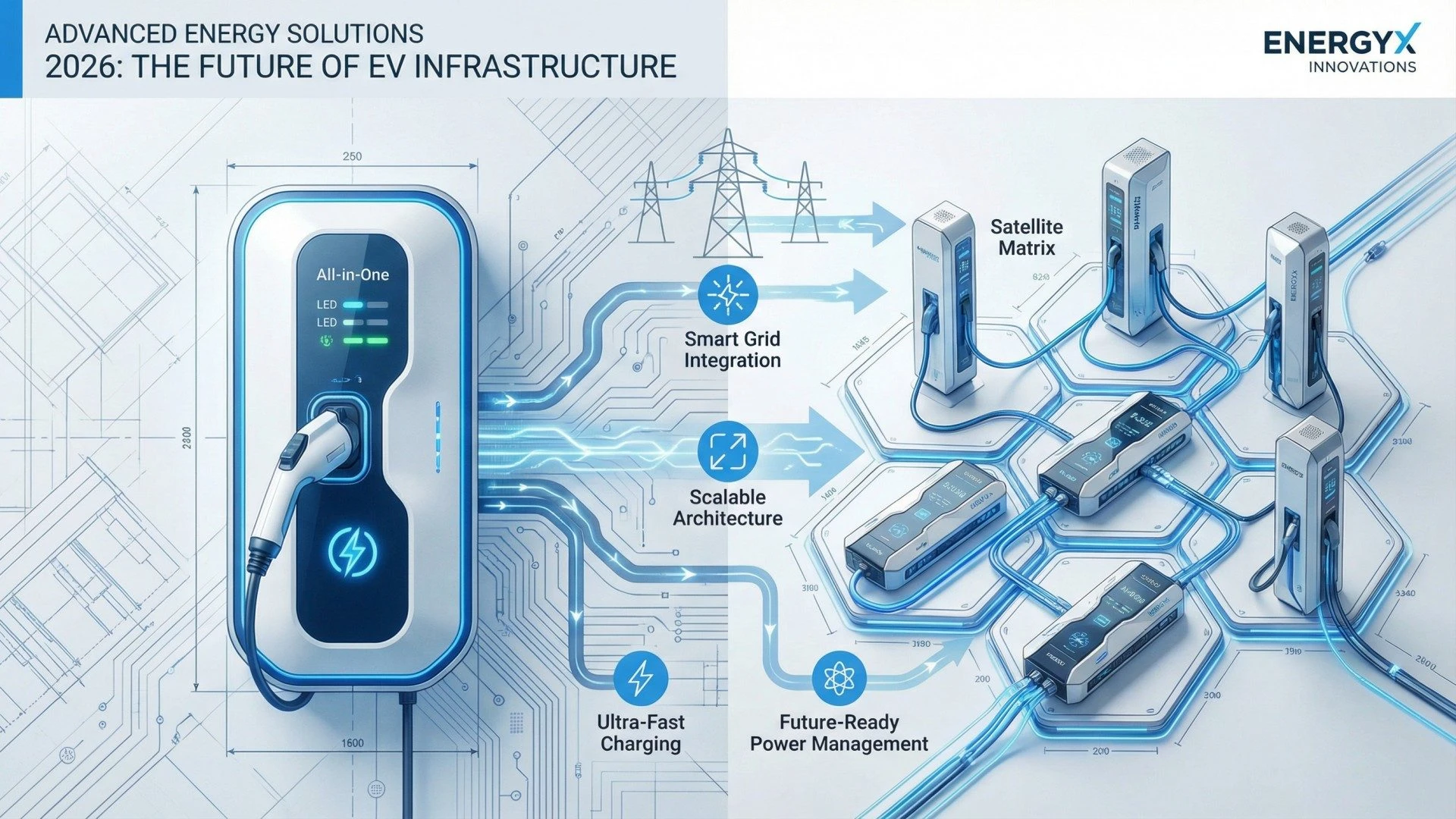
All-in-One: The power conversion modules and the user interface (cables/screen) are in a single cabinet.
-
Modular Design: A centralized “Power Bank” (Matrix) sits separately, distributing power to multiple slim “Satellite” dispensers. In 2026, modular systems are becoming the standard for large-scale hubs.
Q2: Which architecture saves more physical space in 2026 urban sites?
Answer: Modular Design wins for high-density sites. By separating the bulky power electronics from the charging point, the “Satellites” can fit into narrow parking spaces where a standard All-in-One unit would block traffic. MM’s 2026 modular series reduces the footprint at the parking curb by up to 60%.
Q3: How do these designs compare in terms of initial investment (CAPEX)?
Answer: It depends on the number of charging points:
-
All-in-One is cheaper for 1-2 points: Ideal for small retail locations or private fleets.
-
Modular is more cost-effective for 4+ points: While the central matrix is expensive, adding “Satellites” is significantly cheaper than buying multiple standalone All-in-One units. In 2026, this “Shared Power” model reduces total CAPEX by 15-20% for large stations.
| Feature | All-in-One Unit | 2026 Modular Matrix |
| Space Efficiency | High (Self-contained) | Ultra-High (Slim Satellites) |
| Scalability | Limited | Easy (Add modules/dispensers) |
| Maintenance | Unit-by-unit | Centralized (Simpler) |
| Best Use Case | Small retail/Workplace | Highway hubs/Bus depots |
| 2026 ROI Factor | Fast deployment | Long-term operational savings |
Q4: Which system offers better uptime and maintenance in 2026?
Answer: Modular systems offer 99.9% reliability. If one power module fails in an All-in-One unit, the whole charger might go offline. In an MM 2026 Modular Matrix, if one module fails, the system automatically reassigns power from other modules to keep all dispensers running, ensuring zero downtime for your customers.
Q5: How does MM Global Energy optimize these architectures for 2026?
Answer: As a factory-direct provider, we offer Hybrid Solutions.
-
Compact All-in-One (60kW-180kW): Equipped with 2026 smart-cooling tech for limited-space sites.
-
Ultra-Fast Modular (360kW-720kW+): Supporting dynamic power allocation, where the system sends more juice to the car that needs it most, maximizing 2026 utilization rates.
Conclusion: Data-Driven Choice for 2026
There is no one-size-fits-all. If you are starting a small site, All-in-One is your best entry point. If you are building a 2026 flagship charging hub, Modular Design is the key to scalability and lower TCO (Total Cost of Ownership).
Need a site layout analysis? Talk to MM Global Energy experts for a customized 2026 infrastructure plan.